Signs Your Property Management Company Needs Outsourced Accounting
ArrayRunning a property management company involves much more than leasing properties and handling tenant requests. Behind daily operations, teams must manage rent collections, vendor invoices, property expenses, bank reconciliations, owner statements, and monthly financial reports. As a portfolio grows, these accounting responsibilities can become increasingly difficult to manage with a small internal team.
When financial tasks begin affecting daily operations, it may be time to consider outsourced property management accounting. The right accounting support can help property managers improve reporting processes, manage recurring financial tasks, and create more time to focus on properties, tenants, and business growth.
But how can you tell when your company needs additional accounting support? Here are some common signs to watch for.
1. Your Monthly Financial Closing Takes Too Long
Monthly financial closing involves reviewing transactions, recording expenses, reconciling bank accounts, processing invoices, and preparing financial statements.
If your team regularly struggles to complete these tasks on schedule, your accounting workflow may need attention.
Common warning signs include:
- Monthly reports are consistently delayed.
- Bank reconciliations remain incomplete.
- Vendor invoices are waiting to be processed.
- Owner statements require repeated corrections.
- Financial information is not ready when management needs it.
Delays in the month-end close can affect decision-making and create additional work in the following reporting period. External accounting support can help establish a consistent process for completing recurring tasks on time.
2. Bank Reconciliations and Financial Records Are Falling Behind
Property management companies handle transactions across multiple properties, bank accounts, tenants, owners, and vendors. Maintaining accurate records becomes harder when transaction volumes increase.
If your team has a growing list of unreconciled transactions, unexplained differences, or old outstanding items, it may indicate that the existing process is not keeping pace with the business.
Regular reconciliation helps identify:
- Missing rent deposits.
- Duplicate or incorrectly recorded payments.
- Unmatched vendor transactions.
- Bank charges that have not been recorded.
- Differences between accounting records and bank balances.
- Issues involving tenant, owner, or security deposit ledgers.
A structured reconciliation process helps keep financial records reliable. Where trust or security deposit accounts are involved, companies should also follow applicable state requirements and maintain the necessary separation and documentation.
3. Property Owners Frequently Question Their Statements
Owner statements help property owners understand rental income, maintenance expenses, management fees, distributions, and outstanding balances.
When statements contain errors, arrive late, or lack clear transaction details, property owners may begin requesting frequent explanations.
For example, an owner may question why a maintenance expense was deducted, why a payment is missing, or why the reported balance does not match the expected distribution.
These issues may indicate problems with transaction coding, documentation, reconciliation, or the statement preparation process.
Reliable outsourced property management accounting support can help property managers organize financial information, review transactions, and prepare consistent monthly reports. Clear reporting also helps improve communication between property managers and owners.
4. Vendor Invoices and Accounts Payable Are Piling Up
Property management companies regularly work with maintenance contractors, cleaning services, landscapers, utility providers, and other vendors.
As the number of properties increases, processing invoices and tracking payment deadlines can become difficult.
Some common signs of an accounts payable backlog include:
- Invoices remain unrecorded for several days or weeks.
- Payment deadlines are frequently missed.
- The same invoice is entered more than once.
- Vendor statements do not match internal records.
- Managers spend too much time following up on payment status.
An organized accounts payable process should include invoice verification, correct property coding, approval checks, payment scheduling, and proper recordkeeping.
Outsourcing selected accounts payable activities can provide additional processing capacity while your internal team retains control over approvals and payment authorization.
5. Your Property Portfolio Is Growing Faster Than Your Accounting Team
Business growth is positive, but every new property adds financial activity.
A larger portfolio may involve more tenant records, rent transactions, supplier invoices, maintenance expenses, reimbursements, and owner reports.
An accounting team that managed a smaller portfolio successfully may struggle when the workload increases significantly.
You may notice that:
- Existing staff are spending more time on data entry.
- New properties take longer to set up in the accounting system.
- Financial reports are becoming harder to prepare.
- Management needs more detailed property-level information.
- Additional accounting employees may be required.
This is one situation where outsourced property management accounting can provide flexible support. Depending on the provider’s capacity and agreed scope, selected accounting activities can be assigned externally without immediately expanding the internal team.
6. Your Team Depends Too Much on One Accounting Employee
Some property management companies depend heavily on one employee who understands the accounting software, transaction procedures, reconciliations, and reporting process.
This creates operational risk. When that employee is unavailable or leaves the company, important tasks may be delayed because other team members do not have enough knowledge to complete them.
A more dependable accounting workflow should include:
- Documented accounting procedures.
- Organized access to financial records.
- Standardized reconciliation steps.
- Clear responsibility for each activity.
- Review and approval processes.
- Regular reporting schedules.
An external accounting team can provide additional working capacity and documented processes, subject to a clear division of responsibilities and appropriate internal oversight.
7. Your Property Managers Spend More Time on Accounting Than Operations
Property managers should have enough time to handle leasing, tenant communication, maintenance coordination, property inspections, and portfolio development.
However, when accounting responsibilities become overwhelming, managers may spend a significant part of their day reviewing invoices, correcting entries, following up on payments, and preparing reports.
This can affect operational efficiency and reduce the time available for business development.
Outsourcing recurring financial tasks can help redistribute the workload. Your internal team can remain responsible for property decisions, approvals, and client communication while an external accounting team handles agreed accounting activities.
8. Hiring and Maintaining an In-House Accounting Team Is Becoming Expensive
Maintaining an internal accounting department involves more than employee salaries. Businesses may also need to consider recruitment, training, software, employee benefits, and additional resources.
For companies experiencing fluctuating workloads, maintaining enough internal accounting capacity can be challenging.
An outsourcing arrangement may provide access to additional accounting resources without requiring the company to hire for every task internally.
However, the financial benefit depends on the provider’s fees, the services included, transaction volumes, and the level of internal supervision required. Property managers should compare the total cost and service scope before making a decision.
How Outsourced Accounting Can Support Property Management Companies
When several of these signs appear together, outsourced property management accounting may be worth evaluating.
Depending on the provider and the agreed responsibilities, outsourced accounting support can help with:
| Accounting Task | How It Supports Your Business |
|---|---|
| Accounts payable processing | Organizes vendor invoices and payment records |
| Bank reconciliations | Helps identify and resolve transaction differences |
| Journal entries | Supports accurate recording of financial activity |
| Property setup | Helps create and maintain property records in accounting systems |
| Monthly financial statements | Supports regular property-level reporting |
| Annual budgeting | Helps organize planned property income and expenses |
| Billing and reimbursements | Supports accurate posting of charges and reimbursements |
| Tenant information reporting | Helps organize tenant data and generate relevant reports |
| Payroll entries | Supports the recording of payroll-related accounting entries |
Outsourcing does not mean giving up financial control. Property managers should retain appropriate approval authority, review reports, establish access permissions, and monitor the quality of the work.
What Should You Check Before Choosing an Outsourced Accounting Partner?
Selecting an accounting partner requires more than comparing service prices. Your provider should understand the financial workflows and reporting requirements of property management businesses.
Consider the following factors before making a decision:
1. Experience in Property Management Accounting
Look for a provider familiar with property-level transactions, rent records, vendor invoices, owner statements, and monthly reporting requirements.
2. Software Compatibility
Check whether the accounting team can work with your existing systems. Accountant Anywhere’s property management service information mentions experience with platforms such as AppFolio and Yardi Payscan.
3. Clearly Defined Responsibilities
Agree on which activities the external team will handle and which responsibilities will remain with your internal staff. Define approval procedures, payment authorization, reporting deadlines, and escalation processes.
4. Reporting and Communication
Choose a provider with an agreed reporting schedule and a clear process for handling missing documents, reconciliation differences, and urgent financial queries.
5. Data Security and Access Controls
Discuss how financial documents will be shared, who can access accounting systems, and how sensitive business and tenant information will be protected.
How Accountant Anywhere Supports Property Management Businesses
Managing accounting for residential properties, commercial properties, and homeowners’ associations requires organized processes and reliable financial reporting.
Accountant Anywhere provides outsourced accounting support tailored to US-based property management companies. Its service offerings include accounts payable processing, bank reconciliations, journal entries, setting up new properties in accounting systems, monthly financial statements, and annual budgets.
The company also describes support for billing statements, reimbursements, expense voucher postings, payroll entries, tenant information exports, and rent increase updates. Its property management accounting services mention experience with systems such as AppFolio and Yardi Payscan.
Explore Accountant Anywhere’s Property Management Accounting Services to learn more about the available support.
You can also visit the Accountant Anywhere homepage to explore its broader outsourced accounting solutions for businesses.
For more practical guidance, read the related article Property Management Bookkeeping Checklist for Monthly Financial Close.
Frequently Asked Questions
1. When should a property management company outsource accounting?
A company may consider outsourcing when monthly financial closing is regularly delayed, reconciliations are falling behind, owner statements require frequent corrections, or the internal team cannot manage the growing transaction volume.
2. What accounting tasks can property managers outsource?
Depending on the provider and agreed scope, property managers may outsource accounts payable processing, bank reconciliations, journal entries, property setup, monthly financial statements, budget preparation, billing, and other recurring accounting activities.
3. Is outsourced accounting suitable for small property management companies?
Yes. Smaller companies may use outsourcing to access additional accounting support without building a large internal department. The suitable arrangement depends on the company’s transaction volume, budget, software, and reporting requirements.
4. Can an outsourced accounting team work with AppFolio or Yardi?
This depends on the provider’s software experience and access arrangements. Accountant Anywhere’s property management accounting service page specifically mentions experience with AppFolio and Yardi Payscan.
5. Will a property management company lose control of its finances after outsourcing?
No. Outsourcing selected accounting tasks does not remove management oversight. The company should retain control over approvals, payment authorization, financial decisions, access permissions, and review of completed reports.
6. How can a company evaluate whether outsourcing is cost-effective?
Compare the total cost of the current internal process with the proposed outsourcing fees. Include staffing, training, software, management time, transaction volume, service scope, and review requirements in the comparison.
Conclusion
A growing property management company needs accounting processes that can keep pace with its portfolio and daily financial activity. Delayed monthly closing, unreconciled accounts, repeated owner statement corrections, invoice backlogs, and increasing staffing pressure are all signs that the existing accounting setup may need additional support.
Evaluating outsourced property management accounting can help businesses identify opportunities to improve workflow, organize recurring financial tasks, and maintain more consistent reporting.
The right approach is to define the required services, establish clear responsibilities, protect financial information, and maintain regular internal reviews. With an organized accounting process and the right support, property management companies can dedicate more time to operations, property owners, and long-term growth.
Visit Accountant Anywhere to explore its property management accounting solutions and discuss your business requirements.

Related Posts
Signs Your Property Management Company Needs Outsourced Accounting
Learn More
How to Prepare Monthly Owner Statements for Rental Properties
Learn More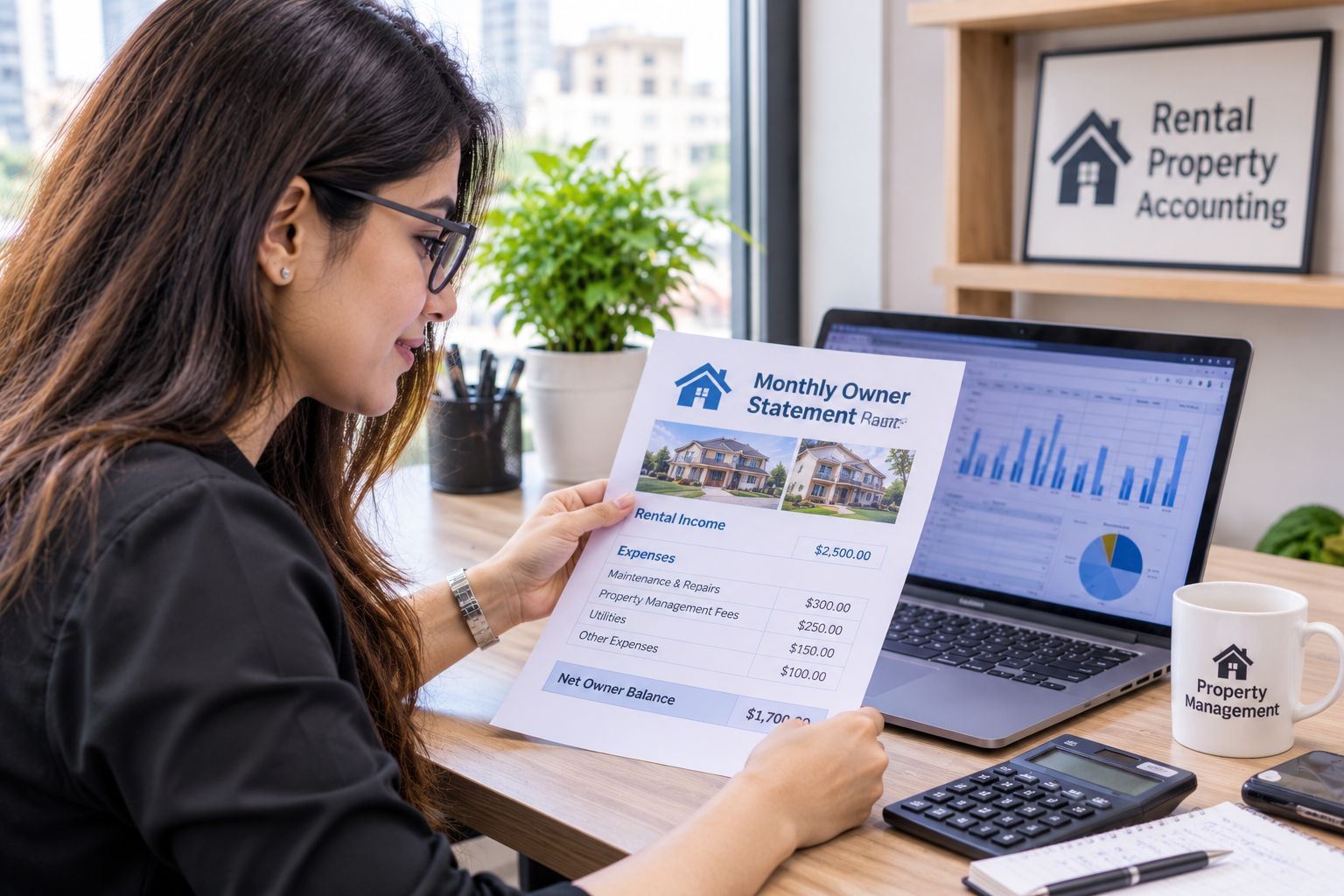
Travel Agency Accounting: Managing Cash Flow and Reconciliations
Learn More
Medical Practice Bookkeeping: A Guide to Financial Reporting
Learn More
Outsourced Accounting Services for US Small Businesses: What to Evaluate
Learn More
Rental Income vs Operating Expenses: A Property Manager’s Guide
Learn More
How to Manage Accounts Payable for Multiple Rental Properties
Learn More
Common Property Management Bookkeeping Mistakes and How to Avoid Them
Learn More
When Should a Growing Business Hire a Fractional CFO?
Learn More
Real Estate Accounting Reports Every Property Manager Should Track
Learn More