How to Prepare Monthly Owner Statements for Rental Properties
ArrayManaging rental properties involves more than collecting rent and paying maintenance bills. Property managers must also maintain accurate financial records, track property-related expenses, reconcile transactions, and provide owners with clear monthly financial updates. A well-prepared owner statement helps property owners understand how their investments are performing and how much income is available after expenses.
Preparing accurate rental property owner statements requires a consistent accounting process. Property managers need to collect the correct financial information, verify transactions, categorize expenses, and present the results in an easy-to-understand format.
In this guide, we explain how to prepare monthly owner statements, which details to include, common mistakes to avoid, and how professional property management accounting can simplify the process.
What Is a Monthly Owner Statement?
A monthly owner statement is a financial report that summarizes the income and expenses associated with a rental property during a specific reporting period. It gives property owners a clear overview of rent collected, expenses paid, management fees, outstanding items, and the resulting property balance.
Depending on the property management agreement and reporting requirements, the statement may include:
- Rental income collected during the month
- Tenant payments and outstanding rent balances
- Maintenance and repair expenses
- Property management fees
- Utility costs and other operating expenses
- Vendor payments and reimbursements
- Owner contributions or distributions
- Beginning and ending account balances
For portfolios with multiple properties, statements can be prepared separately for each property and combined into a portfolio-level summary when required.
Why Are Monthly Owner Statements Important?
Accurate owner reporting supports transparency between property managers and property owners. It also helps owners understand financial performance and identify transactions that may require further review.
1. Better Financial Visibility
Monthly reporting helps owners understand how much rental income was collected and how much was spent on property operations. Consistent reporting makes it easier to compare performance across reporting periods.
2. Improved Expense Monitoring
Itemized expenses allow owners and managers to identify maintenance costs, recurring service charges, and other operating expenses. Reviewing these costs regularly can support better budgeting and spending decisions.
3. Clearer Communication
A well-organized statement reduces confusion about payments, deductions, and outstanding balances. Owners can review the financial activity without having to request details for every transaction.
4. More Organized Accounting Records
Preparing reports monthly encourages property managers to maintain current records and investigate discrepancies before they accumulate. These records can also support year-end reporting and discussions with accounting professionals.
How to Prepare Monthly Owner Statements for Rental Properties
Following a repeatable month-end process can improve the accuracy and consistency of owner reporting.
Step 1: Collect All Financial Transactions
Start by gathering the financial records for the reporting period. These may include bank statements, rent collection reports, tenant ledgers, vendor invoices, receipts, management fee records, and details of owner-related transactions.
Ensure each transaction has sufficient supporting documentation and is associated with the correct property and reporting period.
Step 2: Verify Rental Income
Review the rent ledger and payment records to confirm which payments were received during the month. Record rental income against the correct property and tenant account.
Check for partial payments, late payments, unapplied receipts, credits, and outstanding balances. Avoid treating unpaid rent as collected cash.
Step 3: Record Property Expenses
Identify and categorize expenses incurred or paid during the reporting period according to the property’s accounting policy.
Common categories include:
- Repairs and maintenance
- Landscaping and cleaning
- Property management fees
- Utilities and service charges
- Insurance expenses
- Property-related administrative costs
- Vendor and contractor invoices
Confirm that expenses belong to the correct property and have the necessary invoice or receipt. The statement should distinguish between amounts paid and amounts still payable when that distinction is relevant to the reporting method.
Step 4: Calculate Management Fees and Other Deductions
Review the management agreement to determine the applicable fees and authorized deductions. Management fees may be calculated using an agreed percentage of rent collected or another contractual arrangement.
Check the calculation against the agreement and record the deduction separately. Other deductions should be supported by the relevant invoice, approval, or transaction record.
Step 5: Reconcile Bank and Accounting Records
Compare the accounting ledger with the relevant bank statements and transaction reports. Investigate missing deposits, duplicate entries, bank charges, unrecorded payments, and other differences.
Where applicable, review tenant deposits and other funds separately according to the property’s accounting requirements. Do not include restricted funds as freely available owner income without confirming the appropriate treatment.
Step 6: Calculate the Net Owner Balance
After verifying income, expenses, fees, and other adjustments, calculate the balance to be reported to the owner.
A simplified example is shown below. The figures are illustrative and do not represent a recommended accounting treatment for every property.
| Description | Amount |
|---|---|
| Rental income collected | $2,500 |
| Repairs and maintenance | $200 |
| Property management fee | $250 |
| Other operating expenses | $100 |
| Net amount before other adjustments | $1,950 |
The final amount available for distribution may differ if there are unpaid bills, reserves, prior-period balances, owner contributions, or other adjustments under the management agreement.
Step 7: Prepare the Statement in a Clear Format
Present the financial information in a logical order. Include the property name, owner details, reporting period, opening balance where applicable, itemized income, itemized expenses, management fees, other adjustments, and closing balance.
Add notes for unusual transactions or unresolved items that need the owner’s attention. Keep descriptions clear so owners can understand the purpose of each entry without reviewing the entire accounting ledger.
Step 8: Review and Deliver the Statement
Before sending the statement, verify the calculations, confirm that the figures agree with the underlying accounting records, and check that all required transactions are included.
Follow the agreed reporting schedule and use an appropriate secure method to share financial documents. Retain the final statement and supporting records according to the company’s recordkeeping procedures.
Common Mistakes to Avoid
Even a regular reporting process can produce errors if transactions are not reviewed carefully. Property managers should watch for the following issues:
- Mixing transactions between properties: Always assign income and expenses to the correct property and owner.
- Recording unpaid rent as collected income: Clearly distinguish between rent charged and rent received.
- Missing vendor invoices: Review expense records and outstanding bills before finalizing the report.
- Incorrect management fee calculations: Verify the fee against the management agreement.
- Ignoring reconciliation differences: Investigate discrepancies rather than carrying unexplained balances forward.
- Omitting transaction details: Provide enough information for owners to understand significant expenses and adjustments.
- Sending reports without a final review: Use a documented approval or quality-check process before distribution.
How Accounting Software Can Simplify Owner Reporting
Suitable property management and accounting software can help organize rental transactions, track tenant balances, categorize expenses, and generate financial reports.
Depending on the system and configuration, useful features may include:
- Property-level income and expense tracking
- Tenant payment and receivable reports
- Vendor invoice management
- Bank reconciliation tools
- Management fee calculations
- Monthly financial statement generation
- Document storage and reporting exports
Software can reduce repetitive manual work, but the underlying records still need to be reviewed. Property managers should confirm that reports use the correct accounting settings and reflect the agreed reporting requirements.
How Accountant Anywhere Can Help
Preparing monthly reports for multiple rental properties can become time-consuming as a property management portfolio grows. Consistent transaction coding, reconciliations, expense tracking, and month-end reporting help maintain reliable financial information.
Accountant Anywhere provides accounting support for property management businesses, including accounts payable processing, bank reconciliations, journal entries, monthly financial statements, and annual budgeting support. The exact scope depends on the services agreed with each client.
Explore Accountant Anywhere’s Property Management Accounting Services to learn more about its accounting support for property management companies.
With a structured reporting process and appropriate accounting support, property managers can spend less time assembling financial information and more time managing properties and supporting owners.
Frequently Asked Questions
1. What should a monthly rental property owner statement include?
It typically includes rental income collected, property expenses, management fees, other adjustments, outstanding items where relevant, and the resulting owner balance. The exact format depends on the management agreement and reporting requirements.
2. How often should owner statements be prepared?
Many property managers prepare statements monthly so owners receive regular financial updates. The reporting schedule should be established in the management agreement or service arrangement.
3. What is the difference between an owner statement and a profit and loss report?
An owner statement focuses on the financial activity and balance associated with a particular owner or property under management. A profit and loss report summarizes income and expenses over a period according to the business’s accounting policies. Their contents may overlap, but they serve different reporting purposes.
4. Why is bank reconciliation important before sending an owner statement?
Bank reconciliation helps identify missing transactions, duplicate entries, and differences between accounting records and bank activity. Completing the relevant checks before finalizing a statement improves the reliability of the reported figures.
5. Can property management accounting be outsourced?
Yes. Depending on the provider and agreed scope, property managers may outsource recurring tasks such as transaction processing, accounts payable, bank reconciliations, and monthly financial reporting. Responsibilities, access controls, review procedures, and reporting deadlines should be agreed in advance.
Conclusion
Preparing reliable rental property owner statements requires accurate transaction records, verified rental income, properly categorized expenses, correct fee calculations, and regular reconciliation. A consistent month-end workflow helps property managers present financial information clearly and identify discrepancies before reports are finalized.
By using suitable accounting software, maintaining supporting documentation, and establishing a clear review process, property management businesses can make monthly reporting more efficient and dependable. For additional support with property-level accounting and financial reporting, explore Accountant Anywhere’s Property Management Accounting Services.

Related Posts
Signs Your Property Management Company Needs Outsourced Accounting
Learn More
How to Prepare Monthly Owner Statements for Rental Properties
Learn More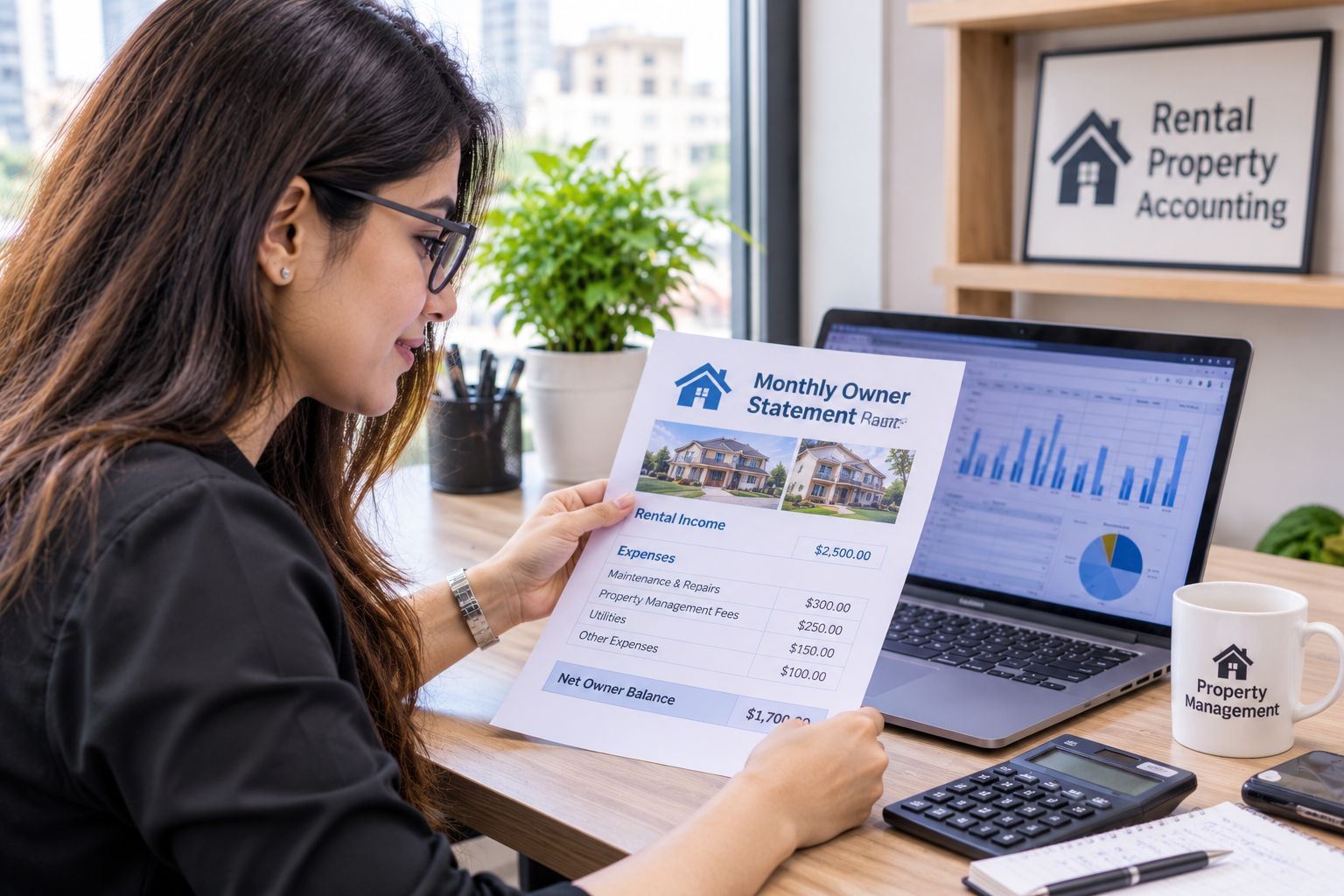
Travel Agency Accounting: Managing Cash Flow and Reconciliations
Learn More
Medical Practice Bookkeeping: A Guide to Financial Reporting
Learn More
Outsourced Accounting Services for US Small Businesses: What to Evaluate
Learn More
Rental Income vs Operating Expenses: A Property Manager’s Guide
Learn More
How to Manage Accounts Payable for Multiple Rental Properties
Learn More
Common Property Management Bookkeeping Mistakes and How to Avoid Them
Learn More
When Should a Growing Business Hire a Fractional CFO?
Learn More
Real Estate Accounting Reports Every Property Manager Should Track
Learn More