What is a property management bookkeeping checklist?
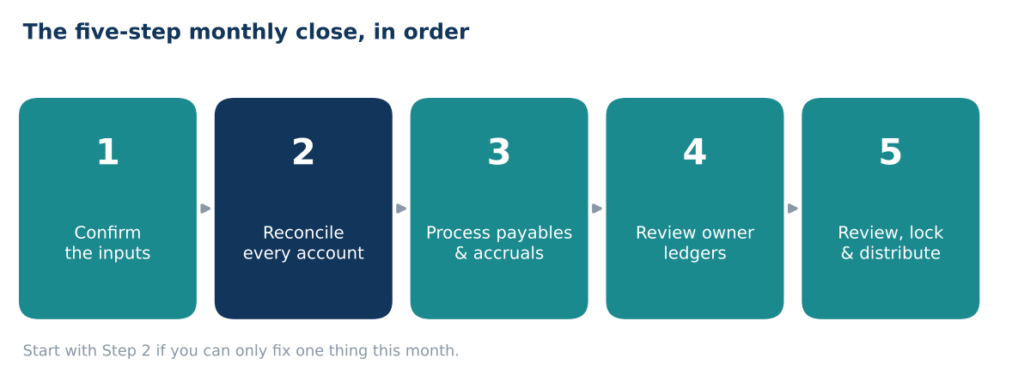
A property management bookkeeping checklist is a repeatable list of tasks that takes your books from raw bank and tenant activity to reviewed, owner-ready financials every month. For most US property managers it comes down to five steps: confirm the inputs, reconcile every account, process payables, review owner ledgers and statements, and lock the period.
Without a checklist, month-end depends on whoever remembers what. Tasks get skipped, owner statements go out late, and small errors roll into the next month. This guide gives you the five steps, a business-day calendar, a manual vs structured comparison, and the metrics worth tracking. If you want the bigger picture first, read what US property managers need to know about property management accounting services.
Key takeaways
- Close the books the same way, in the same order, every month.
- Reconcile every bank account, including security deposit trust accounts, before you review any report.
- Review owner ledgers before statements go out, not after owners ask questions.
- Track days to close and unreconciled items. They show problems early.
- Trust accounting rules differ by state. Confirm yours with your state real estate commission or a licensed professional.
In this guide
- What is a property management bookkeeping checklist?
- Why the monthly close matters
- Where monthly bookkeeping errors come from
- The five-step monthly close checklist
- Sample business-day close calendar
- Checklist-based vs ad hoc close
- Metrics that show whether your close is working
- When to consider outsourced accounting
- Frequently asked questions
Why does the monthly close matter for property managers?
Because you handle other people’s money. Owner funds, tenant security deposits and operating cash must stay separate and traceable, and a clean monthly close is how you show they are.
- Owner trust: Owners judge you by the accuracy and timing of their statements.
- Compliance: Many states require regular reconciliation of trust accounts and record retention. Requirements vary, so check your state’s rules.
- Cash decisions: Owner distributions, reserves and repair approvals all depend on knowing the real balances.
- Fewer year-end surprises: Vendor payments and expenses coded correctly all year make tax-season cleanup much smaller.
Where do monthly bookkeeping errors usually come from?
Most are timing and coding errors, not math errors. That is why a fixed order of work catches them.
| Cause | What it looks like | Caught in |
|---|---|---|
| Rent receipts not recorded or applied to the wrong tenant | Ledger shows a balance due, but the bank shows the payment | Step 1 and 2 |
| Uncleared items left open for months | Reconciliation differences nobody can explain | Step 2 |
| Security deposits mixed with operating cash | Trust balance does not match tenant ledgers | Step 2 |
| Bills coded to the wrong property or owner | An owner is charged for another property’s expense | Step 3 and 4 |
| Missing or unapproved invoices | Expense with no support | Step 3 |
| Management fees or owner draws posted late | Statement does not tie to the payout | Step 4 |
| Period reopened after statements go out | Numbers change after the owner has seen them | Step 5 |
Want a deeper list? See common bookkeeping mistakes property managers make and how to avoid them.
The five-step monthly close checklist
Work through the steps in order. Each task is one line you can tick off.
Step 1: Confirm the inputs
- All rent and fee receipts for the month are posted, including online payments and checks deposited
- Every deposit batch matches a bank deposit
- New leases, renewals, move-ins, move-outs and rent changes are entered in your property software
- Late fees and other charges are posted according to each lease
- Vendor invoices received through month-end are logged
Step 2: Reconcile every account
- Operating account(s) reconciled to the bank statement
- Security deposit trust account reconciled
- Separate owner or reserve accounts reconciled
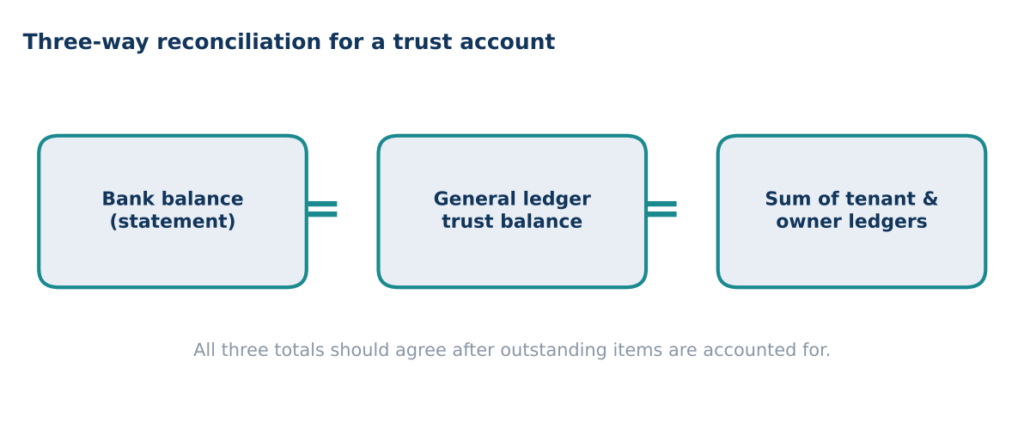
- Trust accounts pass a three-way check: bank balance, general ledger balance and the total of individual tenant and owner ledgers all agree
- Uncleared items listed with dates, and anything old investigated
- Payment processor and credit card clearing accounts reconciled
Step 3: Process payables and accruals
- Bills approved and coded to the correct property, owner and expense category
- Support (invoice or work order) attached to each bill
- Month-end payables recorded in the correct period
- Vendor W-9s on file and payments tracked for 1099 reporting (confirm current IRS thresholds)
- Owner-chargeable expenses kept separate from management company expenses
Step 4: Review owner ledgers and statements
- Management and leasing fees calculated as the management agreement says
- Owner distributions reflect any required reserve
- Negative owner balances investigated before any payout
- Each statement ties out: opening balance + income – expenses – distributions = ending balance
- Large variances against last month explained in a short note
Step 5: Review, lock and distribute
- Income statement, balance sheet and delinquency report reviewed
- A second person signs off on the close
- Period locked so later changes need approval
- Owner statements sent and copies filed
- Open issues logged for next month
What does a sample business-day close calendar look like?
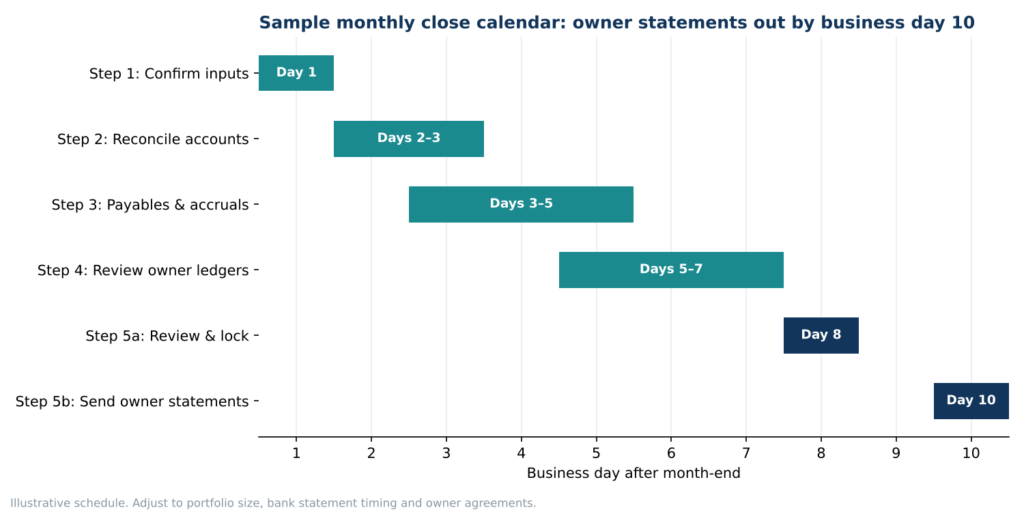
A target calendar gives the team deadlines. This one is illustrative; adjust it to your portfolio size, bank statement timing and owner agreements.
| Business day | Step | Output |
|---|---|---|
| Day 1 | Step 1: Confirm the inputs | All receipts and lease changes posted |
| Days 2–3 | Step 2: Reconcile every account | Signed-off reconciliations |
| Days 3–5 | Step 3: Process payables and accruals | Approved, correctly coded bills |
| Days 5–7 | Step 4: Review owner ledgers | Draft owner statements |
| Day 8 | Step 5: Review and lock | Locked period |
| Day 10 | Step 5: Distribute | Statements sent to owners |
How does a checklist-based close compare with an ad hoc one?
The difference is less about speed than about predictability.
| Area | Ad hoc close | Checklist-based close |
|---|---|---|
| Task ownership | Whoever remembers | Named owner for each task |
| Order of work | Changes month to month | Same sequence every month |
| Reconciliations | Done when time allows | Done before any report is reviewed |
| Error detection | Owner questions after statements go out | Internal review before statements go out |
| Sign-off | Often none | Second-person review |
| Timing | Drifts later over time | Target business days |
| Audit trail | Files scattered across email and drives | Support attached and period locked |
Which metrics show whether your close is working?
Measure your current month first, then set targets from your own baseline. There is no universal benchmark.
| Metric | How to measure it | What it tells you |
|---|---|---|
| Days to close | Business days from month-end to locked period | Where the bottlenecks are |
| Unreconciled items | Count and dollar value older than 30 days | Whether stale items are hiding errors |
| Statements sent on time | Percent of owner statements sent by your target day | Owner experience |
| Post-close adjustments | Entries made after the period is locked | Gaps in the review step |
| Delinquency | Rent unpaid beyond 30 days as a percent of rent billed | Cash flow risk |
Track these in the same place every month so trends are easy to spot.
When should you consider outsourced property management accounting?
Consider it when the checklist is sound but your team cannot finish it on time. Common signs:
- The close regularly slips past your target day.
- Reconciliations are behind, or stale items keep growing.
- One person holds all the knowledge, and the close stalls when they are out.
- Your portfolio is growing faster than your back office.
- Owners keep questioning their statements.
Curious why others are making the move? Read why property management companies are turning to outsourced accounting services.
Need help closing the month on time?
Our property management accounting services cover monthly reconciliations, owner reporting and close support, so your team can focus on residents and properties.
Explore property management accounting services Book a free strategy call
Frequently asked questions
How often should property managers reconcile bank accounts?
At least monthly, as soon as the bank statement is available. Some states set specific trust account reconciliation requirements, so check your state’s rules.
What is a three-way reconciliation?
It compares three totals for a trust account: the bank balance, the general ledger balance and the sum of the individual tenant or owner ledgers. All three should agree after outstanding items are accounted for.
How long should the monthly close take?
It depends on the number of units, your software and how clean the data is. A common internal goal is the first 10 business days, but set yours from your own baseline and your owner agreements.
Who should review the close?
Someone other than the person who prepared it. In a small company, that can be the principal broker or owner.
Can I run the close in spreadsheets?
For a very small portfolio, yes. As the number of units grows, property management software with trust accounting reports reduces manual matching. Either way, keep every reconciliation and its supporting documents.
Do I need a CPA as well as a bookkeeper?
Bookkeeping keeps the records accurate each month. A CPA is typically involved for tax filings and advice, so ask yours how they want the records delivered.
Conclusion
A good monthly close is the same five steps in the same order every month: confirm the inputs, reconcile, process payables, review owner ledgers, then lock and send. If you can only fix one thing this month, start with Step 2 and reconcile every account before you look at any report. For a broader view of period-end work, see mastering the art of closing your books.
This article is general information, not legal, tax or accounting advice. Trust accounting and licensing rules vary by state, so confirm requirements with your state real estate commission or a licensed professional.